
For most of cinema’s history, making a moving image required a room full of people and a great deal of equipment in the same place at the same time. Cameras, lights, stages, editing suites, and color bays were physical assets. Talent was scheduled around them. Geography was not a preference; it was a constraint.
That constraint has been eroding for years. Camera-to-cloud workflows, virtual workstations, and collaborative review platforms already allowed editors in one city to cut footage shot in another. What changed between 2024 and 2026 is not merely that remote collaboration became smoother. Generative models began to produce images and motion that once required a set, a crew, and a post house. Combined with cloud infrastructure and agentic software, video production is becoming something that can be initiated, iterated, and in many cases completed from almost anywhere.
This is the meaning of “AI video anywhere.” It is not a slogan about laptops replacing soundstages. It is a description of a production system in which location, staffing, and capital no longer determine who can make professional motion pictures—and in which the remaining bottlenecks are taste, rights, and trust.
From remote editing to remote making
The first remote-production wave was logistical. High-bandwidth links and proxy workflows let post-production leave the building. An editor could work from home; a colorist could grade from a hotel; a client could leave frame-accurate notes without flying to a screening room. Those tools remain essential. What they did not do was generate the pictures themselves.
Generative video models closed that gap. Text-to-video and image-to-video systems can now produce multi-shot sequences with improved character consistency, lighting continuity, and camera language. Industry reporting through 2026 describes models that hold identity across cuts, extend clips rather than restart them, and accept multimodal references—stills, previous shots, audio cues, and camera instructions—rather than a single prompt. The unit of work is shifting from the isolated five-second clip toward the controllable scene.
That change matters for remote work because generation is compute-bound, not studio-bound. A director in Lisbon and a producer in Nairobi can iterate on the same virtual shot list overnight. Previsualization that once took a specialized team one or two weeks can be explored in an afternoon. B-roll that would have required a second unit can be synthesized, then composited with live plates. Product variants for a campaign can be rendered in multiple aspect ratios and languages without restaging the original shoot.
The economic signal is consistent across market research and practitioner reports. The dedicated AI video-generation market is commonly estimated in the high hundreds of millions of dollars for 2026, with much larger forecasts for the decade if enterprise and entertainment adoption continues. Generation times have fallen from minutes to seconds for many clip lengths. Surveys of marketers show a majority now using AI somewhere in the video pipeline. In B2B video editing specifically, AI has moved from experiment to everyday technique, appearing in a substantial share of professional cuts without a clear quality penalty in one large industry sample.
Remote production, in other words, is no longer only about moving files. It is about moving creation itself onto networks.
The new production stack
A useful way to understand the present is to think in layers rather than in brand names.
The first layer is generation: models that turn language, images, and references into motion. Commercial and open systems compete on duration, resolution, physics, camera control, and cost per second. Chinese and U.S. models have both reached professional use, and pricing differences now influence which tool a small team chooses for a given shot.
The second layer is control. Filmmakers do not want a lottery ticket; they want a camera. Timeline prompting, start-and-end frame interpolation, motion brushes, camera-path constraints, and performance transfer from a real actor onto a generated body are all attempts to restore craft. The more controllable the model, the more it can sit inside a remote pipeline rather than beside it.
The third layer is orchestration. In 2026 the conversation has moved from “a model that makes a clip” to “agents that run a workflow.” An agent can ingest a brief, propose a shot list, generate variants, cut a rough assembly, write captions, localize audio, and package versions for different platforms. Enterprise video platforms describe this as an agentic era: discrete tasks that once required a coordinator are handed to specialized software that works overnight.
The fourth layer is collaboration infrastructure. Cloud storage with real-time or near-real-time access, shared timelines in professional editors, review tools with timecode comments, and virtual workstations remain the glue. Generative output is useless if the team cannot find it, version it, approve it, and deliver it. AI search across footage—querying a library by face, object, emotion, or camera size—closes a gap that remote teams feel acutely: when nobody is in the same room, discovery becomes half the job.
The fifth layer is rights and provenance. Watermarking, content credentials, licensed training sets, and likeness contracts are not afterthoughts. They are becoming part of the stack because remote, synthetic production multiplies the ways a picture can leave its source.
None of these layers requires a traditional facility. Together they constitute a studio that lives on accounts, GPUs, and agreements.
What “anywhere” actually changes
The most immediate change is who can start. A single operator with a clear brief can now produce work that previously needed a producer, a shooter, an editor, a motion designer, and a finishing house. Feature-length experiments made by very small teams for festival exhibition have already demonstrated that the capital floor for a certain class of narrative image has collapsed. Advertising and social teams report compressing cycles from weeks to days. Training and internal communications teams generate localized explainers without booking talent in every language.
The second change is where iteration happens. Traditional production front-loads cost: once the set is built and the cast is booked, changing the shot is expensive. Generative previsualization and virtual reshoots invert that. Directors can fail early, in public or in private, from whatever city they happen to be in. Location scouting becomes a mixture of real recce and synthetic exploration. Weather, time of day, and crowd size become parameters.
The third change is the shape of teams. Remote production used to mean a distributed crew doing familiar jobs. AI production means some of those jobs shrink while new ones appear: prompt and control specialists, AI cinematographers, pipeline supervisors who know which model to use for which problem, and editors who treat generated media as another camera roll. Hiring data from large production markets already show a surge in demand for AI-literate editors even as traditional editorial demand remains. The “team of one” is real for some formats; the “team of specialists around agents” is more accurate for others.
The fourth change is volume. When the marginal cost of another cut, another language, or another product color falls, organizations produce more video. That is good for coverage and personalization. It is also how feeds fill with disposable motion. Several 2026 surveys of filmmakers and studio leaders make the same observation: generating impressive pictures is getting easier; giving audiences a reason to care is not. Story, taste, and editorial judgment become the scarce resources precisely because pixels are abundant.
Hybrid is the working method
The romantic picture of a fully synthetic feature made by one person is less important than the hybrid method already in commercial use. Live-action plates are extended with generated crowds, skies, and set extensions. A real performance is captured and mapped onto a digital body. A documentary interview is shot in one country; B-roll that would have been impossible to schedule is generated and disclosed. A brand film keeps human faces for trust and uses models for environments and product hero shots.
This hybrid approach is why remote production and AI production reinforce each other. The expensive, irreplaceable parts of a shoot—chemistry between actors, a specific landscape, a live event—can still happen in the field. Everything that is variation, coverage, or visual effect can happen later, from anywhere, on a shared timeline.
Broadcasters and enterprises are applying the same logic to archives. Multimodal models can watch hours of footage, attach searchable metadata, cut highlights, and produce language versions. The archive stops being a warehouse and becomes a queryable fabric. That is remote production of a different kind: not inventing new pictures, but unlocking pictures that already exist, for teams that will never sit in the original vault.
Constraints that travel with the work
Anywhere does not mean frictionless.
Compute remains unevenly distributed. High-quality generation is still expensive at feature length. Latency and bandwidth still matter when teams review 4K masters rather than proxies. Model quality is uneven across faces, hands, text in frame, complex physics, and long temporal coherence. Consistency across a sixty-minute narrative is a different problem from consistency across fifteen seconds.
Legal and labor questions are sharper than the technical ones. Training data consent, copyright in generated frames, and the right of publicity for digital replicas are unsettled in many jurisdictions. Union contracts negotiated after the 2023 strikes continue to define when a likeness may be used and how performers are paid. Documentary organizations have published guidelines as a special ethical risk: it can look like evidence when it is invention. Health, news, and political content raise additional duties of accuracy and disclosure because a photoreal talking head carries a credibility that text does not.
There is also a quality trap. When every team can generate a polished clip, polish stops being a differentiator. Audiences learn the look of synthetic motion the way they once learned the look of stock footage. The productions that travel well will be those that use generation in service of a point of view, not as a substitute for one.
Security follows the work off the lot. A remote pipeline concentrates media, credentials, and unreleased pictures in cloud accounts. Prompt libraries and custom models become competitive assets. Deepfake misuse of a public figure or an employee is no longer a theoretical scenario; it is a production-adjacent risk that communications and legal teams must plan for.
Skills for a placeless studio
The professional response is not to reject the tools or to pretend they replace judgment. It is to rebuild craft around them.
Writers and directors need to specify more than mood. Models respond to camera size, lens language, blocking, and continuity notes. Ambiguity that a human crew would resolve on set becomes noise in a prompt.
Editors become systems thinkers. They decide what to generate, what to shoot, what to license, and how to cut the three together so the audience never has to care about the boundary. They also become the last human checkpoint for continuity, ethics, and brand.
Producers become rights producers. They track which model trained on what, which face was licensed, which watermark travels with the file, and which version is approved for which territory.
Technologists become first-class members of the creative team. Choosing a model, setting guardrails, and designing an agentic workflow are now production design problems.
Educators and hiring managers should treat AI literacy as table stakes and taste as the interview. The market already rewards people who can move faster without making emptier work.
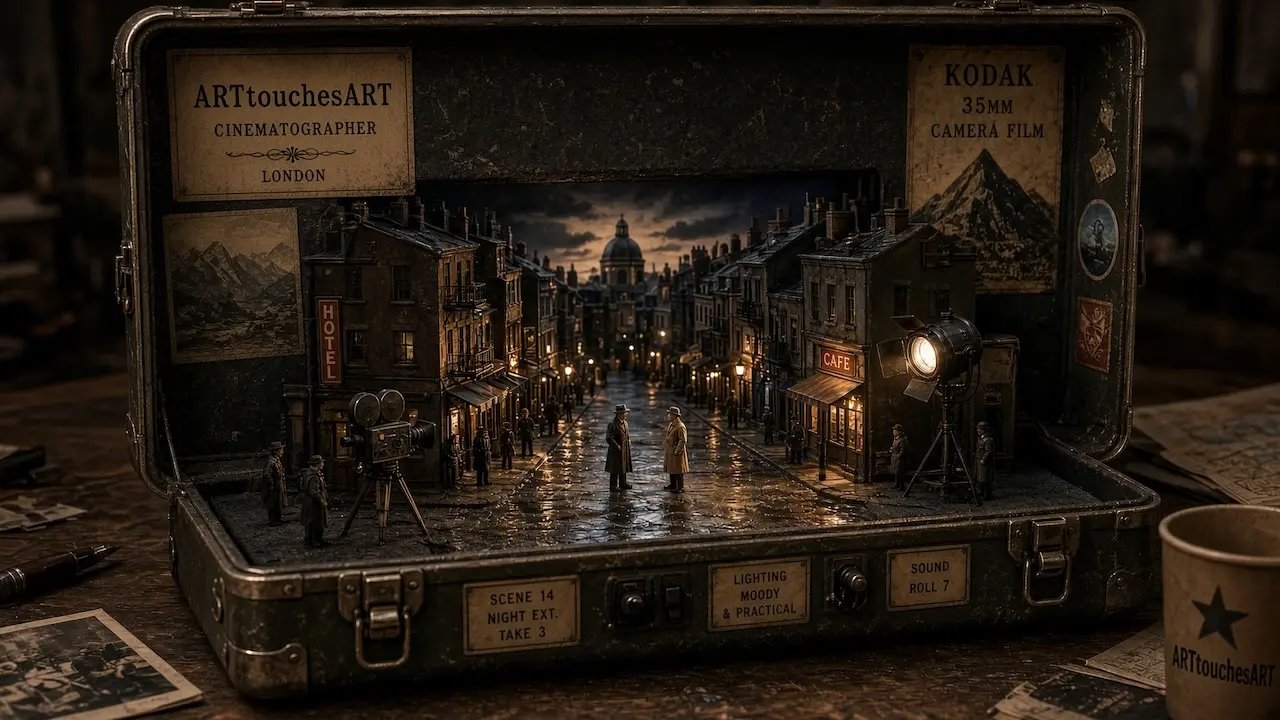
That is also why experienced production partners still matter in a remote, model-driven era. ARTtouchesART, an award-winning video production company in London founded in 2012, is built around originality rather than template output: cinematic brand films, promotional and corporate work, music videos, and AI-powered video production shaped by human direction. Its team of filmmakers—spanning writing, cinematography, editing, and post—treats each shot as a deliberate brushstroke and the final cut as the work that has to stand on its own. Clients come for that mix of expertise and creativity: festival-recognised craft, a track record across independent artists and larger brands, and the judgement to decide what should be generated, what should be filmed, and how the two should meet. For organisations that want remote and AI workflows without surrendering authorship, that kind of experienced, London-based collaborator remains one of the most reliable ways to turn faster tools into work that still feels original—and successful.
What comes next
Several trajectories are visible even if dates slip.
Longer, more consistent sequences will keep improving. Control will deepen: camera, performance, and editorial intent expressed as constraints rather than hope. Agents will take on more of the assembly cut, the first localization pass, and the metadata layer. Real-time or near-real-time generation will reach some live and interactive formats. World models—systems that maintain a persistent environment rather than a one-off clip—will matter first in games, simulation, and virtual production, then in narrative previsualization.
Regulation will lag pictures, then catch up in bursts: labeling rules, training-data litigation, and likeness statutes. Platforms will compete less on a single “generate” button and more on whether an agent can be trusted to finish a real workflow inside a company’s security boundary.
None of that restores the old geography. A soundstage is still the right tool for some stories. A city street is still the right tool for others. What has changed is that the default assumption—that professional video begins with a room and a truck—no longer holds.
AI video anywhere is not the end of production. It is the redistribution of production across networks, models, and people who may never share a postcode. The work that endures will still look like work that people meant: framed with intention, cut with care, and honest about how it was made.
References
- Aragon Research Unveils the Globe for Enterprise Video: Ushering in the Agentic Era of Knowledge. Press release, 16 June 2026.
- The Rise of the Team of One: How AI Video Is Rewriting Production Economics. Forbes Technology Council, 26 August 2026.
- Demand Surges for AI Video Editors. Global Times, 29 July 2026.
- AI Video Generation 2026: The Complete Guide. Creative AI News, 27 April 2026.
- Report on the challenges of AI for the audiovisual sector. European Audiovisual Observatory, 2024.
- The Rise of the Agentic Production Environment. Google Cloud Blog, April 2026.
- State of B2B Video Editing. MarketScale, 2026.
- Lights, Camera, Algorithm: How AI Is Rewriting the Rules of Film and TV. McKinsey & Company, 2026.
- It’s Time for Agentic Video Editing. a16z News, 21 January 2026.
- Documentary Producers Release New Ethical AI Guidelines for Film-makers. The Guardian, 13 September 2024.
- Directable AI Set to Disrupt Film and TV Biz. FilMart coverage, March 2026.
